Transmission Security
Communication with the management system is carried out via Ethernet (TCP/IP) at 10/100 Mbps. Within the system, the controllers utilize two independent, surge-protected RS485 buses. The first is used to support input and output modules, while the second is dedicated to readers operating in various standards, such as OSDPv1, OSDPv2, and EQUbus. The maximum bus range is up to 1000 m with a dedicated cable and 300 m when using Category 5 twisted-pair cable.
Security between reader and card
The IFTER system employs multi-level data encryption at every stage of transmission: from the card, through the reader and modules, up to the management system. The authorization process is implemented using the AES-256 standard, while session-based data transmission is protected by the AES-128 algorithm with a rolling key. The controller remains invisible to unauthorized scanning attempts (no response to PING packets), protecting it from network attacks. At the hardware level, the devices feature Ethernet surge protection up to 150A and RS485 bus protection up to 600W.
Durable construction
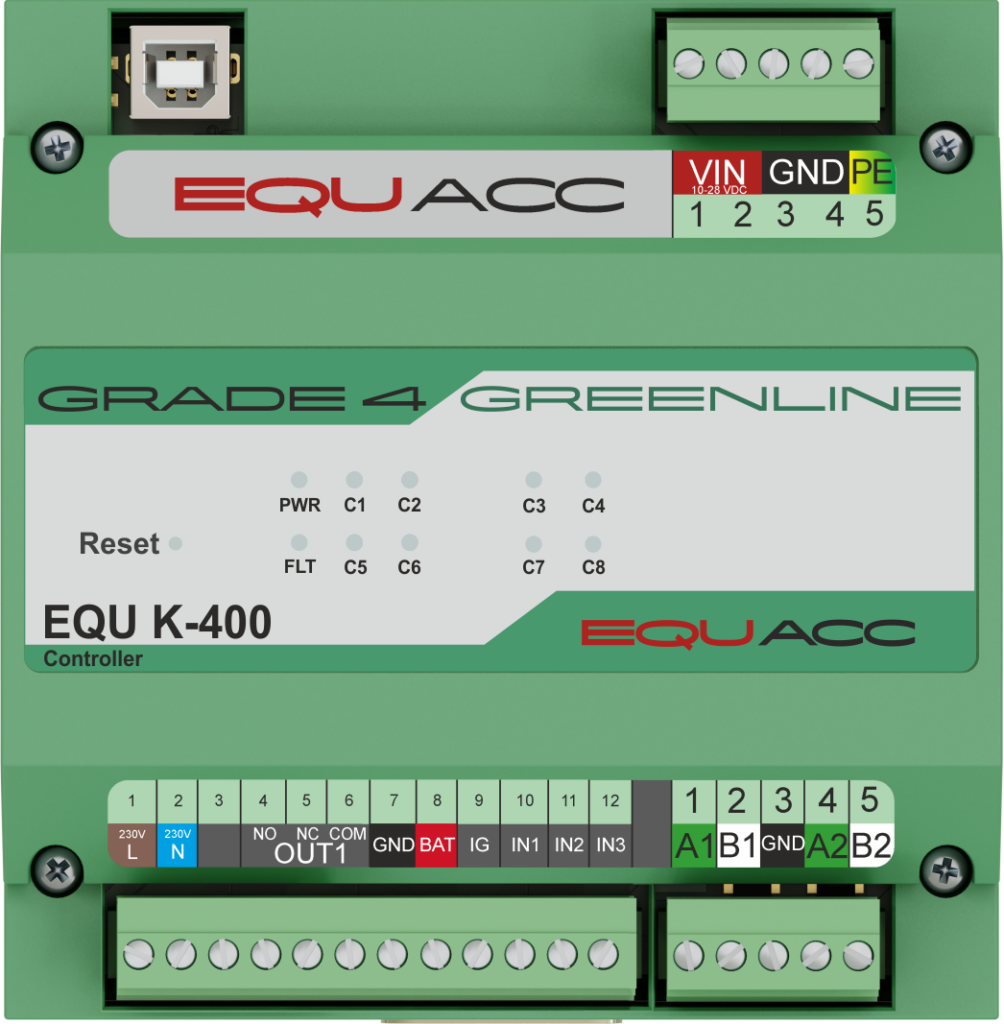
EQU ACC controllers are supplied in modular housings adapted for mounting on a standard DIN-35M rail, which facilitates installation and potential system expansion.
Compact dimensions (123 x 120 x 50 mm) allow for optimal space management in control cabinets.
The devices are equipped with relay outputs with a load capacity of 1A at 24 VDC and parametric control inputs capable of distinguishing open, closed, short-circuit, and sabotage states.
Communication and power supply
The application of network architecture enables the connection of distributed locations into a single, centrally managed ecosystem, supporting up to 65,000 controllers within a single network. The IFTER EQU ACC supervision system automatically detects new units, and upon restoring the connection from offline mode, immediate synchronization of event data and permissions takes place.